Art and Culture

It is most interesting to note that Danes were at the forefront of the modernisation of Bangkok. The British, Chinese and other nationalities were busy transforming the country through trade, concessions and commerce, but several residents here from Denmark helped to develop the infrastructure and transportation systems that really laid the early foundations of the city, most notably with the electric trolly car system, hotel construction. electricity generation, and road building. Here are stories of two of the most noteworthy Danes of fame!

Admiral Andreas du Plessis de Richelieu

Admiral de Richelieu was born in Loit, Denmark on 24 February 1852. He was descended from a very prominent and extensive European family connected to Danish nobility. In 1875, de Richelieu arrived in Bangkok with the letter of introduction by King Christian IX of Denmark. He was an ambitious young Danish naval officer eager to serve in his new home. King Chulalongkorn (King Rama V) appointed him as the captain of the royal yacht where he served in that position for a number of decades. Because King Rama V spent a lot of time on his yacht travelling around Thailand and all over SE Asia, he and de Richelieu spent a lot of time together onboard becoming very close friends. King Rama V trusted the young naval officer to keep him out of ‘shoal waters’ (or serious trouble afloat as we say in the Navy) and he did. King Rama V appointed de Richelieu to a number of increasingly important positions in the Royal Thai Navy.

The short Franco-Siamese War found de Richelieu in command of the military forces at the Phra Chulachomklao Fortress during the Paknam Incident of 13 July 1893. That action ended the war. On 16 January 1900, de Richelieu became the first and only foreign born commander-in-chief of the Royal Thai Navy when he was appointed an Admiral and Minister of the Navy. He served until 29 January 1901. In appreciation for his outstanding services to the nation, he was granted the Thai noble title Phraya Chonlayutthayothin (Thai: พระยาชลยุทธโยธินทร์).

He finally returned to Denmark in 1902 having contracted malaria. The day de Richelieu departed, King Rama V and members of the Royal Family saw him off to Singapore on board the Royal Yacht “Maha Chakri” as a sign of their true friendship. He became a prominent businessman later chairing three out of the four largest companies in Denmark. He died in 1932 and is buried in Copenhagen, Denmark.

Jennie Neilsen

Jennie Neilson (her last name is spelled Nielson on her gravestone) was born in Aalborg, Denmark on 18 September 1849. As a young woman she emigrated to the United States and lived there for a few decades. In October 1884 (the Neilson-Hays Library website lists 1881 as the year she emigrated), Jennie came to Thailand as a protestant missionary. She later married Doctor Thomas Heyward Hays, an American physician, who became the Chief of the Royal Thai Navy Hospital.

About 1900, Jennie became very heavily involved in the Bangkok Ladies’ Library Association. That circulating library was founded by thirteen American and British ladies in 1869. Until that same year, when the Suez Canal was opened, it could take up to six months for mail and books to arrive in the Kingdom. These ladies wanted to contribute to the betterment of the foreigners who lived in Bangkok as the cultural amenities and other diversions were in short supply. Books were considered precious commodities, to be treasured, read and re-read then loaned to others. It was a modest start staffed by only volunteers. The modest lending library had a peripatetic existence. always moving to whatever rent free building or home (or even a chapel) would have them. By 1897 the library was open every day of the week except Sundays with a paid librarian in residence.

It was clear by 1914 a permanent home was needed. A plot of land on Surawong Road was purchased. Jennie served as the library president three times and was closely involved with the effort to secure a reliable place for the collections as a mainstay supporter. Jennie unexpectedly passed away on 26 April 1920, perhaps from cholera. In an effort to honour his late wife’s cherished memory, Dr. Hays built The Neilson-Hays Library in her memory. He commissioned an elegant new library building in her name as a permanent memorial. It opened on 26 June 1922.

0 comment
0 FacebookTwitterPinterestEmail

Physical Geographers have never placed the Chao Phraya River on the list of the world’s longest rivers like the Nile, or on the list of rivers with the highest volume flow like the Amazon. They have never included the Chao Phraya on the list of rivers with the most spectacular viewpoints like the Colorado River inside the Grand Canyon or idyllic, picture postcard like scenery like the Rhine in Germany.

However, at the top of the list of the most commercially valuable, agriculturally abundant and culturally important rivers is the Chao Phraya or, as it is sometimes referred to, the River of Kings. Historians have surmised that the Thais have always lived in river valleys. On their emigration Southwards from China into what is now the Chao Phaya River basin several millenniums ago the Thais found a perfect place to encamp and call it home. There were other ethnic groups living in the Chao Phraya River basin when the Thais appeared, but these groups were all either displaced or forced to move to the surrounding mountains by the growing numbers of more numerous Thais who continued to flood into the whole area. These minority tribes and their descendants are the hill tribes live that in the outer areas today. The Thais found themselves in the perfect place for growing paddy rice crops and vegetables plus tending orchards. It is also an important source of fishes and edible water plants. The grey coloured, fine silt like soil carried into the Gulf of Thailand is the world’s most ideal rice growing region, a title it has held for centuries. The Chao Phraya has made the whole country richly bountiful and prosperous.

The river’s head starts at Nakhon Sawan, at the Northern edge of the Central Plains. This is where the Nan and Ping Rivers meet to form it. It slowly meanders South for 265 kilometres before ending up in the Gulf of Thailand. It is interesting to note that the Nan and Ping are actually both longer, 555 and 590 kilometres respectively. The Chao Phraya watershed is the largest watershed in Thailand. It covers approximately 35% of the nation’s land. It drains an area of 157,924 square kilometres.

Some modern geographers believe the original Chao Phraya River was much longer than it is today. Th river is believed to have actually originated in the Tibetan Himalayans and flowed into the Gulf of Thailand. But tens of thousands of years ago it was “beheaded” by the Salween River in Burma, being much younger and faster flowing. Whatever the true geological origins of the river are, there is no question that the Chao Phraya River has played a primary role in the historical development of the Thai kingdoms located in the central river valley. For centuries until now, the river has served as the primary means of transportation and communication with the outside world. It made Ayutthaya and Bangkok prosperous cities.

For centuries, “farang” visitors have always wondered where the river’s original name came from, since Thais call all rivers “Menam” or “Mother of Water” that sowed a lot of confusion as in all western countries every river, stream, branch and waterway has its own name. It was King Mongkut (King Rama IV), who spoke English, offered the first credible explanation in 1850 when he was interviewed by Dr. Dan Beach Bradley for the Bangkok Courier newspaper. King Mongkut explained that Menam is a generic word like the word river is in English. The Thais attached the name of the largest town or village along it, so the name would have been “Menam Bangkok.”

Like all other rivers that flow from a low elevation headwaters with a heavy silt load, like the Mississippi, Niger and Yellow Rivers, the Chao Phraya moves slows and meanders forming sinuous loops along the way. To speed the time of transportation and shorten the distance the Thais cut canals between the loops. In 1538, a three kilometre long canal was dug at the order of King Chairachathirat called “Khlong Lat”. It shortened the route to Ayutthaya by 13-14km for ships from the Gulf of Siam. In 1542, another two kilometre canal was cut called “Khlong Lat Bangkok.” The Chao Phraya then diverted along the new canal. It’s old course became part of Khlong Bangkok Noi and Khlong Bangkok Yai. It shortened the river route by 14km.

The Chao Phraya River remains at the heart of the Thai civilisation.

0 comment
0 FacebookTwitterPinterestEmail

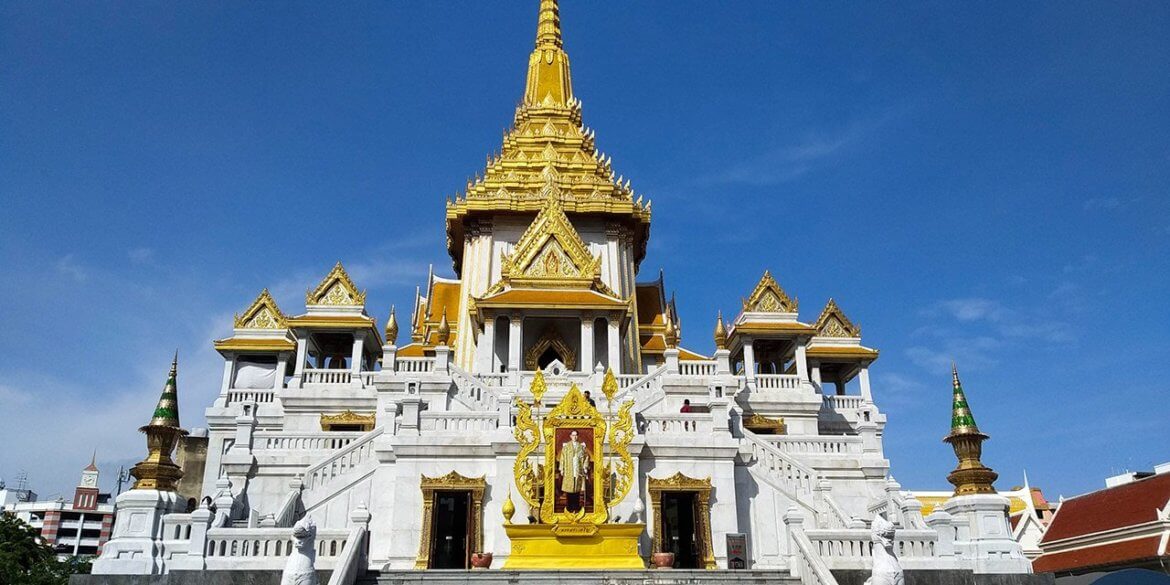
I remember exactly when I heard the story when and how the solid Gold Buddha image was discovered at Wat Trimitr for first time. I was in the 5th grade. It was a beautiful spring day back in April 1962. And I was reading about how and when the priceless statute was found in a world geography textbook that had interesting vignettes from countries around the world, including Thailand.

The story went that an old temple in Bangkok was being moved to new quarters in the mid 1950s. Among the items to be moved was an old, large plaster or stucco-covered Buddha statue. It was late in the day when the workers hooked the statue up to a crane and tried to hoist it up onto a truck bed, but the restraints unexpectedly broke. The statue was dropped, being too heavy to lift and the covering was cracked. The workers just left the statue where it was since it as getting too dark to work any longer. However, that night there was a terrific rainstorm.

When the workers returned, the next morning, they saw something glittering beneath the cracked covering which had been partially washed away in the rainstorm. Upon further investigation it was discovered that inside the outer covering was a gold Buddha image. The rest of the covering was quickly removed. They found it was a solid gold Buddha worth millions of dollars that had sat on the temple grounds for several decades, unbeknownst to everyone. The explanation said that the Buddha statue was covered up to prevent it from being melted down during the Burmese invasion of Ayutthaya in 1767. I was fascinated to hear about this very exotic land.

The solid gold Buddha is known in Thai as Phra Phuttha Maha Suwan Patimakon. This Gold Buddha statue is the world’s largest. Like almost all of Thailand’s history, the solid gold Buddha’s origins are obscured in myth or legend. As the Thais left no written records, what records they did have were religious tracts. Almost all of them were burned, did not last or lost in centuries past. Art historians and experts believe that the statue dates from the 13th or 14th century being crafted during the Sukhothai period. The statue shows Indian influences from the egg shaped head that was typical of the statues made at the time.

Most probably the statue was moved from Sukhothai to Ayutthaya in 1403 when Thailand’s seat of power was moved. Art scholars believe the statue was covered in either stucco or plaster, painted over and then inlaid with coloured glass to disguise it when Burmese invaders attacked and overran Ayutthaya in 1767. So, it escaped the fate of all the other gold and gold covered statues that were melted down and taken away when the city was sacked.

After moving the capita to Bangkok in 1782, King Rama I started to construct many temples in Bangkok. He ordered any Buddhas that still could be found in the ruins of Ayutthaya to be brought to Bangkok for installation. During the reign of King Rama II, the solid gold Buddha was first installed at Wat Chotanaram in Bangkok and later moved to Wat Trimitr when Wat Chotanaram was closed down. Originally called War Sam Chin Tai, Wat Trimitr and is one of the oldest temples in Chinatown. There were three Chinese men who were friends that helped construct this temple for the purpose of merit making. In 1939, the temple was renamed Wat Trimitr Witthayaram literally means three friends.

When the big Gold Buddha statute was moved to Wat Trimitr, the grounds were small and there was no place to display it. So, it as kept under a simple tin roof in storage and forgotten about for some 20 years. About 1954 a Viharn building had been constructed to house the big Gold Buddha. It was moved on 25 May 1955, then the Gold Buddha was discovered. It was found there were actually nine parts that could be disassembled using a key hidden in the base to allow for easier transport.

The statue is 3.01 metres wide, 3.91 metres in height and weighs 5,500 kilograms. On 14 February 2010, a large new building was opened at the Wat Trimitr Temple to house the Gold Buddha. The image remains one of Bangkok’s most visited tourist sites. It remains very fascinating.

0 comment
0 FacebookTwitterPinterestEmail
0 comment
0 FacebookTwitterPinterestEmail

Guardian photographer David Levene visits National Trust houses at Chartwell and Emmetts Gardens to capture the spectacular colours of autumn

Woods within Emmetts Garden
Photograph: David Levene/The Guardian

0 comment
0 FacebookTwitterPinterestEmail

Early newspapers in Thailand were always a hit or miss proposition. However, that did not stop several stalwarts from trying. The first newspaper in any language began in 1844 by Dr. Dan Beach Bradley, an expat who lived here for 35 years. Called ‘The Bangkok Recorder’, it was printed in Thai and English. But the English version only lasted a year and ended due to a poor distribution system. The Thai version was shut down due to lack of interest. Other newspapers were issued by the Thai government throughout the 19th century, but due to the low literacy rate among Thais at the time all were eventually closed.

Actually the oldest newspaper in Thailand is called ‘Royal Thai Government Gazette’. It started its publication in 1858 and is still in publication. In 1864, Mr. J. H. Chandler, published an English -language weekly paper called ‘The Bangkok Times.’ It also lasted a year, shut down by a successful lawsuit for libel brought by an irate reader.

In 1887 Mr. T. Lloyd-Williamese relaunched ‘The Bangkok Times’. This started as a weekly. It soon became extremely popular, so it was published bi-weekly. Its success spawned a competitor called the ‘Siam Free Press’ that started in 1891. Although printed in English, it was primarily aimed at the French community. By 1900 ‘The Bangkok Times’ had grown to a six -page broadsheet with the largest circulation of any newspaper. It appeared Monday through Saturday. Although ostensibly an information source, three -quarters of each issue was devoted to advertisements. In fact, the whole front page was devoted to small advertisements much like today’s classified ads.

As the city saw exponential growth and a continuous rise in the number of expats, more newspapers were started. The ‘Siam Observer’ saw its first edition out in 1903. Other English -language newspapers at the time included the ‘Globe’ and the ‘Black and White Budget’. Most foreign news came from Reuters telegrams. Sometimes the telegrams were days out of date after the event and often out of sequence. Major stories were all gleaned and re-written from overseas newspapers, magazines, and periodicals that arrived by steamship. Entertainment was always the most important factor, the truth snuck in occasionally.

Several commentators observed back then that all the newspapers worked in complete harmony with the government. They are very well supplied with official news. But it was also an open secret that the papers received government subsidies. This prevented lawsuits for libel from being brought, forcing the paper to shut down. These government subsidies also laid the groundwork for the policy of ‘prior restraint’ or self-censorship. This policy has continued all throughout the 20th century until today. However, this did not stop individual reporters from editorialising.

The Bangkok Times’ lasted until 1941 when it was shuttered by the Japanese during WWII. It never reopened. In 1946, the ‘Bangkok Post’ was started by Alexander MacDonald. In 1970 ‘The Nation’ newspaper started publication in 1970. Only they remain although The Nation is now online.

0 comment
0 FacebookTwitterPinterestEmail

This year marks 45 years since I first came to Thailand. There have been a few changes over the decades. But remarkably there have been more than a few things that haven’t changed at all. Some random thoughts.

I instantly fell in love with the country as soon as I got off the plane. I was mesmerised with the people, the lush scenery, the exotic scents, the warm weather and warmer hospitality, the gilded temples, the ancient history, the charming customs, and the delicious food. I knew this was place where I wanted to spend the rest of my life. I have been in over 70 countries since I arrived here. I have not changed my opinion. Bangkok has been my permanent base of operations since 1991 when not doing U.S. government contracts in the hottest of hot spots including Iraq, Afghanistan, Bosnia, Kuwait, Nigeria and Houston.

The exchange rate then was steady one U.S. dollar to 20 Baht. Gold was USD$35.00 per ounce. A handmade, finely crafted, personally fitted Italian pair of leather dress shoes were USD$20. A whole closet full the top quality European styled designer suits were a few hundred dollars. I had a steak dinner one evening back then at the Chokchai Steak House. At the time the restaurant was in the Chokchai Building - the tallest skyscraper in Thailand at 26 stories. It had a spectacular view on the 23rd floor. You could look out and only see a few dim houselights to the southern and western horizons and nothing else of note. Most of the scenery was just trees.

The place to shop back then was the newly opened the Siam Center. But I noted with dismay over the years that there was a growing gap between the lowest step of the entrance on the street and the pavement. All due to subsidence caused by underground water pumping. So they periodically kept adding wooden steps each time to close the growing gap. Behind the Siam Center was the elegant, shaded Intercontinental Hotel. The lobby was the perfect place to have some tea while teams of handsome pilots and glamours stewardesses from Pan-Am, SAS, British Airways, Lufthansa and other international airlines that housed their crews there on layovers waltzed through the lobby area.

Long tail boat on tropical beach, Krabi, Thailand

Bangkok’s roads were all literally parking lots. Hiring a taxi cab was all hard bargaining. They were always not in the best of condition, mainly rusty jalopies ready for the scrapyard. Now as then tuk-tuks were too expensive for a ‘farang’ to use. Most of the city’s landscape has changed radically. But certain areas of the city, like Charoen Krung Road, the residential areas of Huay Kwang and Din Daeng and right around the Grand Palace, seem not to have changed at all (except for a few hundred thousand 7-11s stores). Patpong existed, but not Soi Cowboy.

The highway to Pattaya was just a two lane road with heavy traffic. During the rainy season the roadway washed out several times and had to be repaired each time. If you got caught behind a slow-moving lorry it might be some time before an open spot between oncoming traffic let you safely pass, but that opportunity seldom came. South Pattaya Beach Road was just an unpaved track through the jungle with a few scattered ramshackle thatch covered wooden houses. If you wanted any entertainment you had to bring it along with you. Pattaya was the beach road and the back road and nothing more. A bungalow on the beach could be rented for 120B month. The road to Jomtien was also an unpaved track over the hill from Pattaya. It was a pristine stretch of beach and jungle foliage as a backdrop. Few people cared to venture over there. If they did they had the whole beach to themselves.

Unlike some other East Asian nations that long barred ‘farangs’, Thailand rolled the red carpet out since the first European visitors arrived over five centuries ago. Thailand has been described as a ‘crossroads’. What I like about Thailand most is if you want to have fun then there will always be Thais around to help you do exactly that. If you want to be left alone then the Thais will do that too. Thailand is what you make of it.

The world keeps giving me new reasons every day to stay here. As long as the proverbial welcome mat remains out for myself and my family we will.

0 comment
3 FacebookTwitterPinterestEmail
THE HUNTER


A suite of Giant woodcuts by Ralph Kiggell

12 September 2020 – 15 November 2020

Toot Yung art center, Mae Rim, Chiang Mai

Opening reception Saturday September 12, 2020 from 5pm
The Toot Yung art center is pleased to present a special showcase by British printmaker Ralph Kiggell.
Kiggell will be residing at the Toot Yung art center in August of 2020 to produce an exclusive suite of giant woodcut prints. With a special focus on natural materials sourced in the region, he will be working on “Saa” handmade paper from SP Studio, Lampang, and will be guided for his natural dyes by Chiang Mai artisans Slowstitch Studio. This fruitful collaboration will result in giant woodcuts exploring the many poetic, symbolic and ecological aspects of the jungle.

In this suite of prints, Ralph Kiggell enters the forest of his imagination, to create a sequence of giant print-collages made from papercuts and carved woodblocks, monoprinted by hand onto huge sheets of saa paper. Kiggell loosely references folk woodcuts from Europe and Japan, and Ramakien illustrations in Thailand to make his depictions. Using natural pigments and dyes, he works in black, green and indigo, to print a mass of abundant vegetation, where, among trees, lianas, flowers and by a waterfall, we see images of figures, animals and birds. In the pools of darkness and light, who are the hunters, who are the hunted? But within the fantasy, the overriding story is about an earthly paradise that we know may already be lost.
TOOT YUNG ART CENTER

Open by appointment:

74/3 MOO 4, KILEK, MAE RIM DISTRICT,
CHIANG MAI, THAILAND 50180

+66 8 49 14 54 99 (ENG)
+66 8 63 12 13 77 (TH)

[email protected]

0 comment
0 FacebookTwitterPinterestEmail

It is both ironic and amusing to think of the original Bangkok most probably always had a Chinatown. It is believed Chinese traders were living in the small trading post and later customs port from the 15th century. Originally, the Chinese settlers had congregated where the Grand Palace is located today. Following the fall of Ayutthaya in 1767, King Taksin established his new kingdom with his capital at Thonburi (‘Wealth Fortress‘). He received aid from the local Teochew merchants who shared ethnic ties with him. They supplied his new capital with rice and provisions. In return, he granted them many favours, including land on the East bank of the Chao Phraya River, opposite his palace and enclosed by city walls, on which to settle their community. The Teochew prospered under King Taksin, at the expense of the previously influential Hokkien, whose community was located in the area of Kudi Chin on the West bank South of the city.

When King Rama I decided to move the capital from Thon Buri across the river in 1782, he asked the Chinese to move to a swampy, uninhabited area just to the Southeast further along the Chao Phaya River to free up the site of the proposed new palace. He had the palace moved to the East bank of the river, which was more strategically secure. This necessitated the relocation of the Teochew community, a move probably motivated by the fact that the Teochew had been supporters of the King Taksin, while Rama I had ties to the Hokkien. This new ‘Chinatown’ was called Sampeng or Sampheng. The Chinese simply replicated the community they knew in China: two storey shop houses with residences on the second floor, narrow alleyways, good sellers were all tightly clustered together by type or trade. There was one simple dirt thoroughfare called Sampeng Lane.

As wars, famine, and civil strife wracked China, Thailand became a safe haven for more and more Chinese immigrants from the Southern part as the decades passed. As Thailand became stable, trade dramatically increased between the two countries. Every day saw more and more junks appear. Due to a devastating fire that destroyed much of the area 1890, due to the inability of fire trucks to enter the narrow lanes to combat the conflagration. Soon the area was rebuilt with a broader road built in 1891 called Yaowarat.

Began to grow between the two countries. Every single day, more and more Chinese junk boats were bringing goods to Thailand and it was because of these boats that the Wat Yannawa, or the Boat Temple, was built during the Ayutthaya Eera. The main road weaving through Bangkok’s Chinatown is Yaowarat Road, built in 1891. This 1.5 kilometre road is often referred to as being dragon like, weaving in and out of Chinatown’s historical neighbourhood.

Bangkok’s Chinatown is one of the largest Chinatowns in the world. It was founded in 1782 when the city was established as the capital of the Rattanakosin Kingdom and served as the home of the mainly Teochew immigrant Chinese population, who soon became the city’s dominant ethnic group. Originally centred around Sampheng, the core of Chinatown now lies along Yaowarat Road, which serves as its main artery and sometimes lends its name to the entire area, which is often referred to as Yaowarat (Thai: เยาวราช). Chinatown’s entire area is roughly coterminous with Samphanthawong District and includes neighbourhoods such as Song Wat and Talat Noi along the Chao Phraya River, and Charoen Chai, Khlong Thom, and Nakhon Khasem along Charoen Krung Road.

Originally a wilderness area outside the city walls, Chinatown grew to become Bangkok’s commercial hub throughout the late 19th to early 20th centuries but has since declined in prominence as commercial activity moved elsewhere following the city’s expansion. It now serves as a hub of Chinese culture, with numerous shops selling traditional goods, and is especially known as a gastronomic destination.

King Taksin’s reign ended in 1782 when the general Chao Phraya Chakri instigated a coup against him and established the Rattanakosin Kingdom, becoming King Rama I. Rama I had the Teochew resettle in the area of Sampheng, on the river’s East bank Southeast and downstream from the city centre. The area, between Wat Sam Pluem (now Wat Chakkrawat) and Wat Sampheng (now Wat Pathum Khongkha), was then a swampy, inaccessible area. A small road, later to become Sampheng Lane, linked it to the fortified city.

As adept merchants, the Chinese community prospered in trade, and gradually grew as immigrants from China (including non-Teochew minorities) increasingly flooded into Bangkok. Chinatown underwent rapid growth following the signing of the Bowring Treaty, which liberalised international trade, in 1855. Import-export businesses flourished and numerous piers and warehouses arose in the area, their operations further facilitated by the construction of Charoen Krung Road in 1864. Chinatown, now a highly dense shantytown, was ravaged by numerous fires during the second half of the 19th century, which cleared the way for the construction of many new roads, including Yaowarat, during the reign of King Chulalongkorn (Rama V). By the turn of the 19th -–20th centuries, Chinatown had become Bangkok’s main commercial area, as well as a red-light district hosting opium dens, theatres, nightclubs, and gambling houses.

In the 20th century, Chinatown’s commercial prominence gradually declined as businesses and well -off residents moved to newer areas of the expanding city. Those remaining, however, have continued to practice their culture, making Chinatown a centre of Chinese food, crafts, and religion, despite the general Chinese population’s gradual assimilation into Thai society.

The direction of Chinatown’s future again came into question in the 2010s, with the construction of the Blue Line of the underground MRT, whose Wat Mangkon Station will serve the area. There have been calls for urban conservation, among concerns that old communities are being displaced by development.

Areas

Samphanthawong District, containing most of the Chinatown area

Yaowarat: Yaowarat Road is Chinatown’s main artery. It runs from Odeon Circle, where it splits off Charoen Krung Road, to the old city moat of Khlong Ong Ang.

Odeon Circle: A former traffic circle at the beginning of Yaowarat Road, it is the site of the Chinatown Gate, built in 1999.

Sampheng: Now known as Soi Wanit 1, Sampheng Lane was the original street serving Chinatown. Today it is a busy market consisting of numerous shophouses lining a narrow pedestrian alley.

Charoen Chai: A historic community off Charoen Krung Road

Talat Noi: A fringe neighbourhood Southeast of Yaowarat, it is home to several historic buildings.

Song Wat: The street runs alongside the Chao Phraya River, and used to be the site of numerous cargo piers.

0 comment
0 FacebookTwitterPinterestEmail

Bangkok saw a slow expansion to the north and east after New Road was opened in 1864, then a rapid expansion started in the 1880s. Soon land speculators and property developers started looking at buying plots in this area. After Klong Silom was excavated by the government in 1858, three more parallel klongs, or canals, were eventually dug for public transportation. However, these were private initiatives paid for by land developers. They were permitted to sell the land on either side of it to private buyers. In 1888, what would become Sathorn (or Sathon) Road, first started out as Klong Pohyom or Pohyom canal. It connecting Klong Hua Lampong canal (later Straight Street and finally Rama IV Road) and the Chao Phaya River. After the developers had excavated the canal and built a roadway on top of both earthen banks.

Originally Klong Sathorn was named Klong Pohyom (or ‘Mr. Yom’s Canal’) after the Chinese man who owned the company that excavated the canal. He started selling plots of land upon completion. He was later ennobled by King Chulalongkorn (King Rama V), with the name Luang Sathon Racha Yut, for his accomplishment. The canal became to be known by an element in his title, Sathon or Sathorn.

Rows of trees were planted on both sides of the two roadways giving the thoroughfare a shaded appearance. Spacious homes were the first to be built on both sides of Sathorn Road or along the adjacent side sois. There were offices of French, English, Danish, German, and American doctors, including many Thai medical hospitals and medical practitioners in the immediate area. At the junction of Klong Sathorn and the river, the area was filled with docks and various rice mills. It was also the location of the Chinese port to transport goods and passengers to Singapore, Hong Kong, and China.

The first foreign hospital was the British Nursing Home (BNH) established on Convent Road in 1898 under royal patronage. Initially a small wooden building, it served the needs or resident expats who needed higher quality medical care as a non-profit facility. Later it was renamed the Bangkok Nursing Home and finally just BNH. Also in 1898, St. Louis Hospital was founded as a non-profit French medical treatment facility. Later St. Louis Church was established next to the hospital. The Chinese Chamber of Commerce built an impressive edifice in 1915 to serve as a meeting place for the richest Chinese-Thai merchants and businessmen in the country. Eventually some foreign embassies started to be established along the roadway, including Russia after formal diplomatic relations were started in 1897.

Several wats were already in the general area. These include Wat Yannawa, a temple dating back to the Ayutthaya period and Wat Don, built in 1797. However, in the 1970s the trees were all cut down and the canal was confined to a narrow concrete channel so the roads could be widened, a far cry from the original.

0 comment
0 FacebookTwitterPinterestEmail