Updates

Thailand’s English proficiency ranking amongst non English speakers has fallen for the fourth consecutive year.

According to this year’s English Proficiency Index, which was released last week by Swiss based international education company Education First, Thailand ranked in just 89th place, out of 100 hundred countries surveyed.

With an overall score of just 419, Thailand is regarded as having “very low proficiency”.

This year’s ranking is Thailand’s lowest and represents the fourth consecutive year that Thailand’s ranking has dropped.

In 2019, Thailand ranked 74th out of 100, while in 2018 it ranked 64th out of 88 countries included in the index with a score of 48.54.

Education First described the “very low proficiency” ranking as those countries which can introduce oneself simply (name, age, country /regions of origin), understand simple signs and give basic directions to a foreign visitor.

By comparison, a “high proficiency” are those countries which can make a presentation at work, understand TV shows and read a newspaper, where as “very high proficiency” are countries where someone can use nuanced and appropriate language in social situations, read advanced texts with ease and negotiate a contract with a native English speaker

The index found that Thai men scored slightly higher than women, with scores of 48.68 and 47.59, respectively, both still some way short of the global averages of 53.03 for men and 53.23 for women.

Thailand’s lowely score means that with the exception of Myanmar (93rd), it is outperformed by all of its ASEAN neighbours when it comes to English speaking ability. 

Singapore (10th, vey high proficiency), the Philippines (27th, high proficiency) and Malaysia (30th Moderate proficiency) were the three best performing countries in ASEAN.

Both Vietnam (65th, low proficiency) and Cambodia (84th, very high proficiency) outperformed Thailand.

Globally, the Netherlands ranked in 1st place, while Denmark (2nd), Finland (3rd), Sweden (4th) and Norway (5th) were all found to have “very high proficiency”.

According to its website the Education First English Proficiency Index calculates a country’s average adult English skill level using data from two different English tests completed by hundreds of thousands of adults every year. 

One test is open to any Internet user for free. The second is an online placement test used by Education First during the enrollment process for English courses. Both include grammar, vocabulary, reading, and listening sections.

— © Copyright Thai Visa News 2020-11-25
0 comment
0 FacebookTwitterPinterestEmail
0 comment
0 FacebookTwitterPinterestEmail

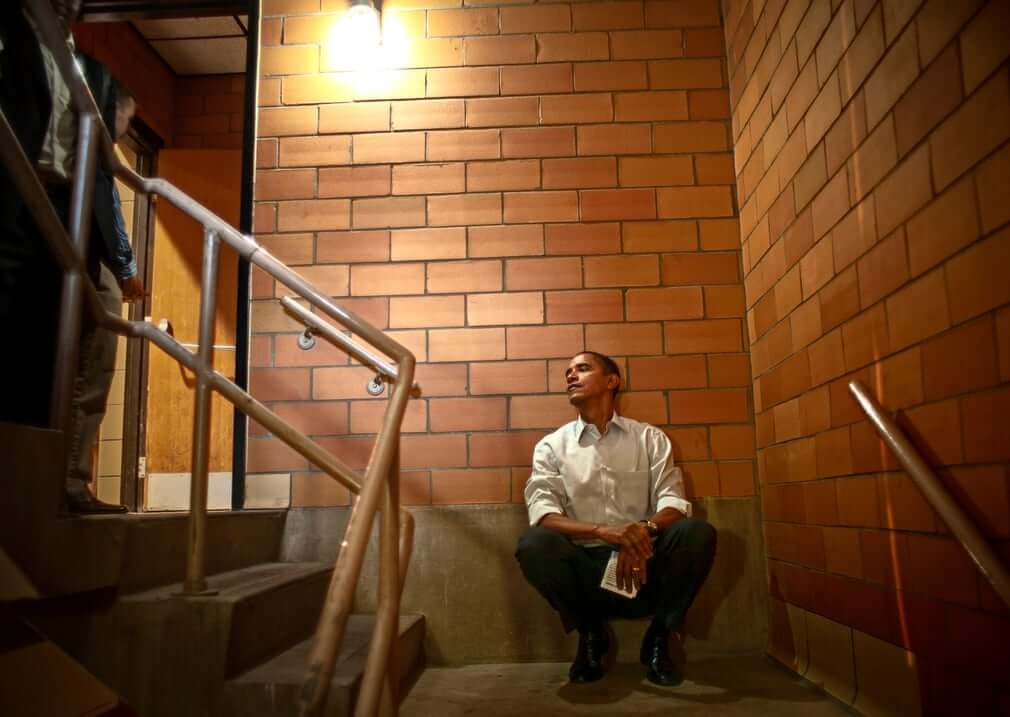
Photographer Callie Shell documented the Obamas at home in Chicago, on the campaign trail and in the White House. Her new book shares candid images from the 10 years she spent photographing the family. Hope, Never Fear is published by Chronicle Books.

Sarah Gilbert

2 October, 2006
Hyde Park, Chicago, Illinois. Barack and the girls get breakfast and wash the dishes. This morning, he took the girls to school and Michelle went to work.
7 November 2007
Muscatine, Iowa. Barack listens from a back stairwell as he is introduced during his first presidential election campaign. It was his second or third speech of the day.
26 January 2008Columbia, South Carolina. Michelle in a hotel room on the morning of the South Carolina primary, which Obama won.
5 February 2008
Chicago, Illinois. The Obamas in a hotel room on Super Tuesday. Michelle looks over Barack’s remarks to supporters before a rally. In a surprising twist, Obama surpassed Hillary Clinton in delegate numbers.
1 March 2008Providence, Rhode Island. Barack does press interviews by phone between events. When he sees Shell photographing his shoes, he says he has already had them resoled once since he entered the race. They were his lucky shoes.
3 May 2008
Noblesville, Indiana. The Obamas campaign at a county picnic in the Forest Park.
4 July 2008
Butte, Montana. The family watch TV on a campaign bus. They had got together to celebrate Malia’s 10th birthday.
30 August 2008
Boardman, Ohio. The Obamas share breakfast with Barack’s running mate, Joe Biden, and his wife, Jill, while on a bus tour of the state.
0 comment
1 FacebookTwitterPinterestEmail
As an international businessman working in Bangkok, Thailand may I make an impassioned plea for all businesses, hospitals, schools, government departments in Thailand to equip their switchboard (and indeed all staff) with a copy of the International Radiotelephony Spelling Alphabet, commonly known as the NATO phonetic alphabet or ICAO phonetic alphabet.
With the greatest respect to our Thai hosts, their pronunciation of the modern English alphabet (the Latin alphabet) which consists of 26 characters is sometimes very difficult to understand.
If they were all issued with a copy of the guide below it would make it a lot easier for all parties.
0 comment
0 FacebookTwitterPinterestEmail
Singles Day 11.11 in China and across SE Asia.
38 Billion USD spent last year - they expect more this year!
Some numerologists and New Age philosophies believe that events linked to the time 11:11appear more often than can be explained by chance or coincidence and is an example of synchronicity. Some authors claim that seeing 11:11 on a clock is an auspicious sign.[ Others claim that 11:11 signals a spirit presence. However, skeptics say that Uri Geller‘s examples of 11:11 phenomena in world events are examples of post-hocreasoning and confirmation bias.

Dealing with the intense astrology of the second half of 2020 hasn’t been a walk in the park — but there are always good days sprinkled in with the storms, and November 11 is one to mark on your calendar. Thanks to the powerful numerology of 11/11, this Wednesday is set to be the luckiest days of the month (and even the entire year).

Nov. 11 brings a once-a-year opportunity to align with the auspicious energy of abundance, spiritual connection, and deep personal awakening. “Nov. 11 is one of this year’s most fortuitous dates,” ascension guide and channeler Laura Browntells Bustle. “It can shift each of our lives for the better [and] set the stage for our next bold move.” And it’s especially magical if you know how to take advantage of 11/11 energy, too

Angel Number 1111 Meanings

1. The Angels Are Helping You Have Better Self-Esteem

One of the meanings behind angel number 1111 is they want you to work on your self-esteem.

The angels have noticed you are very focused on what other people think of you. They want you to love your self and focus on your own impulses and intuition.

If you are very concerned with how many “likes” you get on social media or how big your audience is then this is a message from your angels that your self-worth does not come from the opinions of others. Your self-worth comes from loving who you are on the inside.

Seeing the number 1111 is a sign that they want you to attune yourself to the spiritual dimensions of love and light.

2. The Angels Want You to Make Dream Interpretation a Priority

Another reason you’re being sent the 1111 angel number is that it is time to pay closer attention to your dreams.

Everyone has a different relationship with their dreams, some people feel dreams are just a part of their sleep cycle where information from their day is sorted, other people see dreams as highly symbolic and meaningful.

Some people even engage in lucid dreaming, the act of becoming conscious within your dream state.

When you see angel numbers in your dreams, it could be a sign that your dreams may be sending you symbolic messages you need to be aware of.

There are countless places online and in books where you can go and interpret the symbolism that comes up in your dreams.

You may encounter spirit animals, particular colors, or see friends and family when dreaming. It is thought all of this is your subconscious communicating with you through the language of the universe.

Sometimes the Universe will send you messages in your dreams because you are more open and accepting of spiritual energy while sleeping. When we are in the waking state we are often distracted, rightfully so, with the mundane world.

On the other hand, while we are sleeping, we have no such obligations to attend to, and this is one of the reasons the angels are giving you this message. They want you to wake up to the energy and communications from the Universe by understanding your dreams.

3. The Angels Are Giving You A Sign That A Major Development Is About to Occur

One 1111 meaning is that major changes are happening, typically in a spiritual context! This is a very global and universal numeric message, meaning the changes are on a grand scale. You are seeing the bigger picture at this time or will be soon.

Your angel guides want you to be tuned into the world around you. They want you to understand what is going on so you can be a beacon of hope, love, and support to others.

Alternatively, this could also mean that you are in need of some comfort and support. The angels are giving you this sign so you know assistance is never far away.

If you keep seeing 1111, this means you are most likely part of the world’s spiritual energy update or Earth Ascension process. This means you play a special role in lifting up the spirit of the Earth.

Through kindness, positivity, and a sense of abundance, you play an important part in the bigger picture, in healing of the Earth’s energy.

4) The Angels Are Helping You Discover Your Own Truth

The Number 1 in Numerology, is often seen as a symbol of truth and purity. When it comes to 11:11, its power is quadrupled! This powerful message is nudging you to wake up to your own truth.

This is your chance for some deep soul searching! The angels want you to be living a life that feels honest, and for you to adjust your mindset and goals in order to be more in line with your own truth.

Your guardian angels want you to know that trial and error is part of life. Getting honest with yourself and what speaks to you is the first step in discovering who you really are.

The Angels sent you the angel number 1111 as a sign that you can do this!

5. The Angels Want You to Have Faith

We know there are many painful and difficult aspects of life. One of the meanings behind angel number 1111 are lessons in faith.

Your angels want to help you believe that there is more to life than just the physical world in front of you.

As mentioned by Doreen Virtue in her book Angels 101, often angels will send people this message to help them feel validated in their beliefs.

They know how important it is to you that meaning exists in everything and every situation. You can find comfort in the fact that the angels have your best interest in mind.

As we explained in our ultimate angel numbers guide, when you see 11 11, this is a genuine sign from the angels that you can feel confident in what you believe; it is more than just a coincidence that you keep seeing these numbers.

What Does the Angel Number 1111 Mean for Love?

The 1111 meaning in love is that your guardian angels want you to know that you are loved, and it is possible to love yourself completely.

They want you to know you matter and have something special to contribute to the world.

Also, read some of our other angel number guides:

  • Angel Number 111
  • Angel Number 1010
  • Angel Number 1414

Further Exploration

When you start seeing signs, such as the number 1111, from the Universe the coincidences typically keep on happening.

The best authority on why you keep seeing these signs is you!

When you meditate on the meanings and significance behind each number you will know which messages are meant for you and which ones are not by trusting your own intuition.

What do you think? Which meanings resonated the most with you?

Keep seeing 1111 so much that it’s hard to ignore? If so, we recommend reading Doreen Virtues’s amazing book which gives you an in-depth guide into what angel numbers mean!

Reprinted from - https://numerologysign.com/numerology/angel-numbers/quadruple/1111-meanings/

0 comment
0 FacebookTwitterPinterestEmail
History will show us the damage or otherwise the Trump era has had on the hearts and soul of not only America but the world.
For readers of this space will know that I try to not make many public statements. My SKÅL training has taught me to be open-minded, to listen, to be non-political, accepting of all colours, creeds and religions. Diversity is a part of our lives and often not through our choosing, but something we are born with and above all my training and experience has taught me to show friendship and respect.
My public space, on Facebook particularly, is filled with snippets of my daily life as if you, the reader, were a member of my family. Also I share my own writings and articles plus news and comments that have caught my attention.
I am an avid reader. As a child Enid Blyton’s Famous Five books, comics such as Beano and novels on action and adventure like the Guns of Navarone (Alistair MacLean). At 11 years old I discovered my stepfather’s library of books and read half of them over the next few years.
Today my interest is travel and tourism and I subscribe to a host of popular electronic daily publications. I spend hours scanning them all. If anything catches my eye I often share them on my various platforms and social media groups.
My rationale of what to share is driven by my interests, a career hotel marketeer and hotel general manager, a Skålleague and today an author and commentator with a reach of approx 3 million readers globally.
On my personal blog if I feel strongly about any issue I will preview the article with anAJW Comment:
Throughout the Trump presidency regular readers of my space will have perhaps caught a glimpse of my true feelings about the man. What is utterly evident is that for the past 4 years America has been bereft of an elder statesman.
President-elect Biden’s victory speech was a breath of fresh air. Actually more a storm. Delivered with a gale force intensity and passion, with line after line of memorable and uplifting quotes. Definitely what we need right now.
Biden’s speech was unifying and showed great leadership and confidence, the country can once again feel proud of it’s most senior representative.
Whilst the content was not all new, indeed “ We are not enemies but friends, …” is an excerpt of President Lincoln’s first inaugural address in 1861. However the whole of President-elect Biden’s speech was the very embodiment of ‘Presidential’.
And for travel and tourism? The USA has to win its battle with the virus for recovery to take place. Tackling covid is his first priority and implementing a national strategy and actual real leadership in the White House. Biden will take it seriously and get the A-team on it, without interference. Tough decisions will be needed. Once beaten the world of travel will be able recover and prosper.
0 comment
0 FacebookTwitterPinterestEmail

f all else fails, democracy takes to the street. The street is its last resort. At present, each weekend we see the people of Belarus marching to demand the resignation of their president, Alexander Lukashenko. We see protesters in Thailand are jamming Bangkok to reform their monarchy. Nigerians are rioting in Lagos, Brazilians in São Paulo.

Something about street protest is catching. The past year has seen public violence in Hong Kong, Venezuela, France and Turkey. In the US we are told to expect riots if Trump loses next week’s election. Coronavirus disturbances have begun this week in Italy and are expected elsewhere. Governments are losing their grip. Crowds gather, banners unfurl, defiance is chanted. We have seen nothing like it since the Arab spring, now approaching its 10th anniversary.

Nothing in these demonstrations is remotely effective. At the time of the Arab spring’s “social media revolution” it was trumpeted that numbers amassed through social media and promoted by real-time publicity would make such protests devastating. Observers turned to the pundits, to Elias Canetti on the politics of crowds and Barbara Ehrenreich on the exhilaration of dancing in the streets. This was the new politics of collective action, a cathartic uplift of sympathy and public righteousness. London’s ban-the-bomb and anti-war rallies were recalled. No one registered that these were little more than festivals of protest rather than serious political campaigns. All failed.

We admired the solitary protesters of China’s Tiananmen and Turkey’s Taksim squares, largely because they were photogenic. Likewise, we were persuaded that virtue would triumph in Bashar al-Assad’s Syria, in Nicolás Maduro’s Venezuela and now in Lukashenko’s Belarus. We did not stop to ask whether our distant encouragement helped or hindered their cause. In Hong Kong, Britain allowed demonstrators to think it had some leverage on Beijing that might enable them to win. It did not. They are now facing prison. In Syria, we encouraged the rebels to think we might come to their aid. We did not and they suffered appallingly. We might now ask who gains from the current demonstrations in Philadelphia, which are being seized on as manna from heaven by Donald Trump.

One thing matters in political protest: how will the powerful respond? There is no value in mere numbers, in “raising awareness”, in column inches or high-profile heroes. In this respect an opinion poll is more potent over the powers that be than street protest. If government refuses to give way and can deploy ever more effective policing to sustain itself, demonstrations are just street parties.

The apparent success of uprisings across eastern Europe in 1989 is often cited as street politics in action. The Soviet collapse was nothing to do with the streets but with the collapse of a will to govern by local regimes following decisions taken by Mikhail Gorbachev in Moscow. Power evaporated overnight. Equally, Lukashenko can bash heads in Minsk streets as long as Vladimir Putin is behind him. If there is one thing that will keep Putin supporting Lukashenko it is fear of him capitulating to protest.

I remember attending an anti-Milosevic rally in Belgrade during the Kosovo war. It was unimpressive since Slobodan Milosevic was still popular, but a Serbian observer remarked that the rally was pointless. All that mattered was Moscow. When it suited Moscow for Milosevic to get out of Kosovo he would do so – everything else was country dancing. So indeed it turned out.

Defaulting to mass protest has always seemed the safety valve of democracy and no one likes to call its bluff. The urban mob has certainly played its role in history, in my view much underrated by historians. In London, it was crucial in the English civil war and in the reform crises of 1832 and 1867. Before the advent of democracy – and tear gas and water cannon – it undoubtedly frightened politicians. During the poll tax protests, demonstrators undoubtedly played a part in Margaret Thatcher’s downfall.

The reality is that political reform under any regime comes from within a particular power structure, not from outside, except when faced with naked military aggression. This applied to all the profound transformations of modern times, in Russia, China and South Africa. That is why those now concerned with the shaky condition of democracy should reform its rotten institutions, its parliaments, courts and councils, join political parties and stand for elections – however boring it might seem.

I may regard street protest as often ineffective, but that is not to deny its liberty. It remains democracy’s ultimate freedom. The pandemic has been seized upon by governments round the world as an excuse to curb the freedom to associate and amass an armoury of surveillance, intrusion and citizen control. We are told this is for our own good. Autocrats alway

Article by Simon Jenkins, a Guardian columnist

0 comment
0 FacebookTwitterPinterestEmail

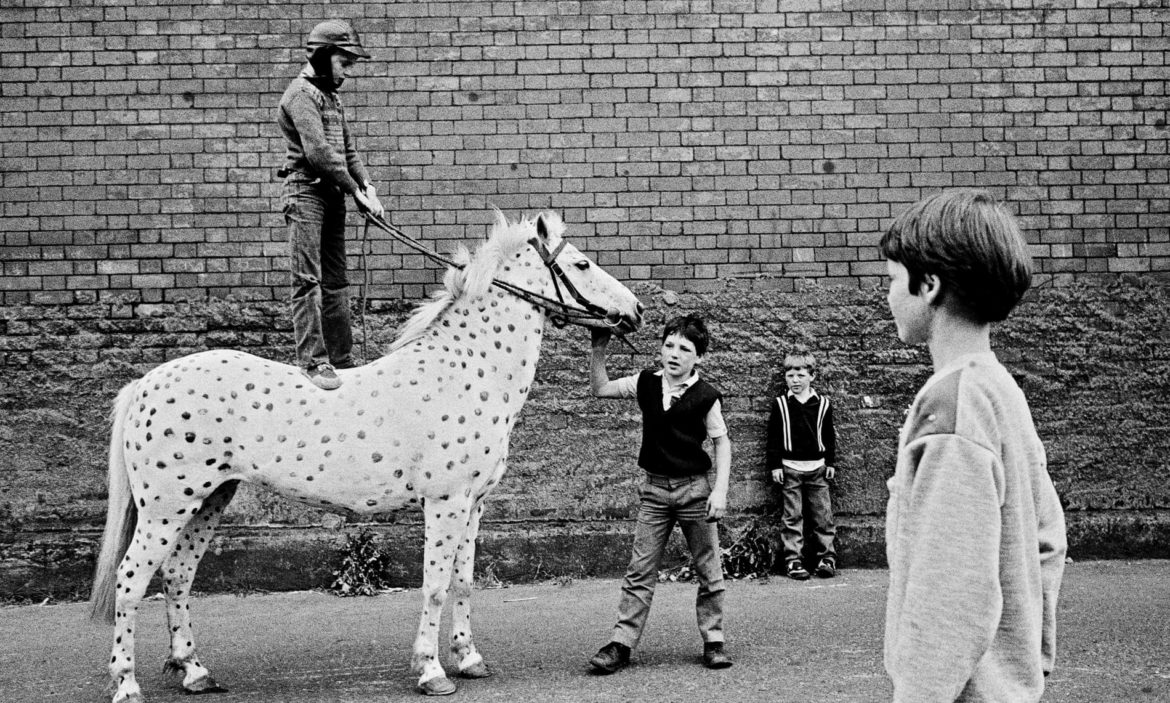
The majority of the photographs were taken in Dublin and County Kerry and, in spectacles of religious processions and marches, marking significant events of the recent past, convey a sense of community.

This is the first retrospective book of work by O’Shea. A large number of the images are previously unpublished.

From city streets to the remote countryside, O’Shea’s photographs document the spectrum of public life across Ireland and Northern Ireland.

Often warmly humorous, the images are unified by his subjects’ dignity and lack of self-consciousness. Collectively, they demonstrate O’Shea’s ability to combine the bleak and the joyful.

As an editor at the magazine In Dublin in the late 1970s, Colm Tóibín sent O’Shea out on Dublin buses to capture the life of the city from the upper deck. Read more by Tim Adams in the Observer on this image of two boys and a kestrel here

Ireland broke a record by making it to the quarter finals without winning a match in normal time. They were eventually beaten 1-0 by the hosts, Italy.

O’Shea’s photographs take in everyday life in markets and on bus journeys.

‘Tony O’Shea is interested in the moment where the ritual and the casual face each other in the complex light that comes from Irish skies. He likes gatherings and public spaces. And he is watching for the second when, even if his subjects are performing, a guard has been let down, and the camera becomes an uneasy, tentative, hesitant window into the soul’ - Colm Tóibín.

‘He seeks images of individual loneliness and isolation, figures in a state of reverie and contemplation, or figures in a state of excitement’ – Colm Tóibín.

An exhibition of O’Shea’s work at the Gallery of Photography Ireland in Dublin is planned for early 202.

0 comment
0 FacebookTwitterPinterestEmail

In 2016, Andrew Woodyatt started working at the Rio cinema in Dalston, Hackney, London. Handed a large bunch of keys, and blessed with a healthy curiosity, he started to explore the Rio’s basement rooms, which had been used for years for storage. Among the broken hoovers and discarded paperwork, he started to come across negatives – local street scenes shot on film strips, which seemed interesting enough to save. Then he hit the jackpot. Opening a rusty filing cabinet, he found 10,000 frames, mounted on glass slides and neatly organised into folders, some with labels such as “NHS”, “Greenham Common” and “Colin Roach”. “I just thought ‘Wow!’” says Woodyatt, who also lectures at Goldsmiths, University of London.

Woodyatt had stumbled across the remains of the Rio Tape/Slide Newsreel Group, a project that ran at the Rio from 1982 until 1988, facilitated by a young woman called Sandra Hooper. The aim of the project was simple – to give local people audio equipment, cameras and training so they could make newsreels about their area, which would be shown at the cinema before the films. Only a couple of the newsreels have survived and none of the audio recordings, but the photographs are a thought-provoking dive into a tumultuous time in Hackney – and in Britain.

Margaret Thatcher had been in power since 1979, and unemployment had reached over three million; relations between minorities and the police were still strained after the race riots of 1981. The 1984-85 miners’ strike pitted workers and their unions against the government, and Thatcher and Ronald Reagan’s bullish approach to the cold war sparked off fears of a nuclear war. Those who were poor started to feel disenfranchised, and people in Hackney were among them. The area around the Rio was famed for its bad housing, in which young squatters took over empty, rotting properties; it was also known for its longstanding openness to immigrants, who faced the sharp end of racism and discrimination. “These were tough times,” says Woodyatt. “In the early 80s, more than half the tickets sold at the Rio had an unemployed discount.

But Hackney didn’t take it lying down, with protests and community groups regularly calling for change. The file Woodyatt found labelled NHS showed protests against cuts organised by the Hackney Health Emergency, for example, while the Greenham Common folder showed support for the Greenham Common Women’s Peace Camp, set up in 1981 in opposition to nuclear weapons placed at the RAF base. The Colin Roach file showed some of the many protests demanding a public inquiry into the death of the 21-year-old black British man in nearby Stoke Newington police station on 12 January 1983. Other images show demonstrations against council spending cuts, deportations and evictions; or collections of money or food for the miners.

There are also happier or more everyday images, taken on the street, on buses, in community groups or at festivals, some showing people looking happy, industrious or cool, others focusing on cars, shop fronts, markets and housing estates. Some show shady scenes, such as a police stop-and-search that escalated into a major incident – images that MP Brian Sedgemore used to make a case against dogs in local policing. Other images testify to the very real poverty experienced in Hackney at the time, as well as the amazing mix of residents.

That mix was reflected in The Rio Tape/Slide Newsreel Group. Run for two hours every Thursday afternoon in term time, its participants were often out of work or only casually employed, and in their teens to early 30s; other than that, they came from a wide variety of communities and backgrounds, be that black, white, gay, straight, working or middle class. Their differences didn’t impede their work. “It was great!” says Dee Phillips, who grew up in the area and took part. “Everyone had a great sense that everybody, young or old, would have their say, and that their contribution was just as important. Everybody had a voice.”

“It felt very open,” says Hooper. “We always met at the beginning of the allocated two-hour class, and we would spend the time talking about what we wanted to cover and how to do it. I don’t think there was any sort of difficult, conflicting opinions – that was one of the things that made it work. The nature of the project interested people who were open to thinking about things.”

And that open-mindedness was key, because it was also in the project’s nature to be alternative. Run by locals for locals, in a very multicultural community facing severe deprivation, it included topics that didn’t make it into the national or even local press, and a perspective from outside the establishment. The group presented the views of squatters at a time when Hackney Council was sealing up empty properties (though the Labour council was also considered so radical that some newspapers tagged it “loony left”). Kath Hornak, for example, squatted in Hackney for over three years, and was photographed protesting at the town hall about access to housing. “I saw many evictions,” she says, “and I was shocked to see the council then go in and smash up the toilets and sinks to make the place uninhabitable.”

The newsreels also reported why the family of Colin Roach – who died after two gunshots to the head – wanted an inquest into his death, at a time when, according to those involved, other newspapers simply regurgitated the official line. “The press in the main took the perspective that the guy had walked into a police station and killed himself,” says Ngoma Bishop, who was part of the Roach Family Support Committee. “How did they know this? The police had told them. The police, from the night of Colin’s death, started to put out their narrative, so people would think he was some guy from Hackney with mental illness. We had to counter that, so we organised a press conference at a community centre. The press listened, and wrote things we hadn’t said at all.”

That sense of polyphony, of alternative perspectives, underpins The Rio Tape/Slide Archive, a forthcoming book put together by Woodyatt with three others – Alan Denney, a local photographer and historian who took on the monumental task of cleaning and scanning the slides; Tamara Stoll, a photographer and artist who specialises in community projects; and Max Leonard, a writer and publisher. All four live in Hackney – Leonard grew up there, and Denney moved there in the 1980s – and the book includes an essay by Woodyatt on the history of the Rio, and another by Denney on the context of 1970s and 80s community photography. There are also introductions by Michael Rosen and Zawe Ashton, both of whom lived in Hackney. But other than that, it’s the people who were involved with Hackney and the Rio Tape/Slide Newsreel Group who tell their stories, via a series of oral histories.

“It seemed fitting,” says Leonard. “I write books, but I didn’t want to write this one – I didn’t want to put my own voice in there. We wanted to let different people put different points of view, especially as the book is about lots of different communities and protests and politics.”

These interviews also put the images into context, helping ensure the social and political era in which they were made is clear, and the issues and perspectives they presented aren’t written out of history. These issues and perspectives feel relevant again now, against a backdrop of movements such as #MeToo and Black Lives Matter, and for Phillips, that’s bittersweet. “Nurses fighting for fair pay, representation of race and class – all those issues are part of the here and now,” she says. “These problems are still here. It doesn’t feel we have moved on, and that makes me sad.

“But I’m happy people will know that we, as a group, were concerned, and did try to let people know what was going on. I look back with fond memories. It was a brave time.”

  • The Rio Tape/Slide Archive Book is out this week, published by Isola Press

  • The Hackney in the 1980s exhibition is available to visit in person at Hackney Museum. For more information on how to book a free slot, click here. A live-streamed opening event will be held online on Thursday 29 October from 6pm-7pm. Tickets are free. To book, visit Eventbrite.

0 comment
0 FacebookTwitterPinterestEmail

Delayed freeze in Laptev Sea could have knock-on effects across polar region, scientists say.

For the first time since records began, the main nursery of Arctic sea ice in Siberia has yet to start freezing in late October.

The delayed annual freeze in the Laptev Sea has been caused by freakishly protracted warmth in northern Russia and the intrusion of Atlantic waters, say climate scientists who warn of possible knock-on effects across the polar region.

Ocean temperatures in the area recently climbed to more than 5C above average, following a record breaking heatwave and the unusually early decline of last winter’s sea ice.

The trapped heat takes a long time to dissipate into the atmosphere, even at this time of the year when the sun creeps above the horizon for little more than an hour or two each day.

Graphs of sea-ice extent in the Laptev Sea, which usually show a healthy seasonal pulse, appear to have flat-lined. As a result, there is a record amount of open sea in the Arctic.

“The lack of freeze-up so far this fall is unprecedented in the Siberian Arctic region,” said Zachary Labe, a postdoctoral researcher at Colorado State University. He says this is in line with the expected impact of human-driven climate change.

“2020 is another year that is consistent with a rapidly changing Arctic. Without a systematic reduction in greenhouse gases, the likelihood of our first ‘ice-free’ summer will continue to increase by the mid-21st century,’ he wrote in an email to the Guardian.

This year’s Siberian heatwave was made at least 600 times more likely by industrial and agricultural emissions, according to an earlier study.

The warmer air temperature is not the only factor slowing the formation of ice. Climate change is also pushing more balmy Atlantic currents into the Arctic and breaking up the usual stratification between warm deep waters and the cool surface. This also makes it difficult for ice to form.

“This continues a streak of very low extents. The last 14 years, 2007 to 2020, are the lowest 14 years in the satellite record starting in 1979,” said Walt Meier, senior research scientist at the US National Snow and Ice Data Center. He said much of the old ice in the Arctic is now disappearing, leaving thinner seasonal ice. Overall the average thickness is half what it was in the 1980s.

The downward trend is likely to continue until the Arctic has its first ice-free summer, said Meier. The data and models suggest this will occur between 2030 and 2050. “It’s a matter of when, not if,” he added.

Scientists are concerned the delayed freeze could amplify feedbacks that accelerate the decline of the ice cap. It is already well known that a smaller ice sheet means less of a white area to reflect the sun’s heat back into space. But this is not the only reason the Arctic is warming more than twice as fast as the global average.

The Laptev Sea is known as the birthplace of ice, which forms along the coast there in early winter, then drifts westward carrying nutrients across the Arctic, before breaking up in the spring in the Fram Strait between Greenland and Svalbard. If ice forms late in the Laptev, it will be thinner and thus more likely to melt before it reaches the Fram Strait. This could mean fewer nutrients for Arctic plankton, which will then have a reduced capacity to draw down carbon dioxide from the atmosphere.

More open sea also means more turbulence in the upper layer of the Arctic ocean, which draws up more warm water from the depths.

Dr Stefan Hendricks, a sea ice physics specialist at the Alfred Wegener Institute, said the sea ice trends are grim but not surprising. “It is more frustrating than shocking. This has been forecast for a long time, but there has been little substantial response by decision-makers.”

0 comment
0 FacebookTwitterPinterestEmail