Author

Leonard H. Le Blanc III

The most famous American expat in Thai history is “Jim” Thompson, who singlehandedly revived Thailand’s silk industry after WWII. Thompson remains a real legendary figure in Thailand, and throughout all of Asia, even to this day. He continues to inspire the imaginations of those who want to make it big here through hard work and perseverance.

James (“Jim”) Harrison Wilson Thompson (21 March 1906 - 26 March 26 1967, the date he disappeared) was born in Greenville, Delaware. He was the son of a wealthy textile manufacturer. Thompson graduated from Princeton University and did some graduate studies at the University of Pennsylvania School of Architecture.

Thompson moved to New York City in 1931 and worked as an architect design homes until 1940. In 1941, before the start of WWII, Thompson enlisted in the Delaware Army National Guard. He was soon encouraged to join the U.S. Office of Strategic Services (OSS), forerunner of the Central Intelligence Agency (CIA).

After his first OSS assignment in North Africa, Thompson was sent to Sri Lanka in May 1945 to work with the “Seri Thai (or Free Thai” Movement). This underground organisation was dedicated to ending the Japanese occupation of Thailand by clandestine means. The group also had the support of Pridi Panomyong, the regent to King Ananda Mahidol (King Rama VIII) and Seni Pramoj, Thai ambassador to the United States. Thompson arrived in Bangkok shortly WWII ended in August 1945.

In early 1946, Thompson started working as the U.S. Embassy’s military attaché. Also working at the Embassy was Kenneth Landon, an American missionary. His wife, Margaret Landon, was the best selling author of “Anna and the King of Siam”. Her book was made into a movie of the same name in 1946. This was later retitled and filmed in 1956 as “The King and I”. In 1946, Thompson joined a group of investors to buy The Oriental Hotel that was in dire need of restoration, but soon disposed of his shares due to a dispute with the other investors. He then concentrated on the locally woven silk that had caught his attention. Thompson instantly fell in love with the texture, colours and vibrancy of the scintillating silk material. He also found the whole industry was on the brink of extinction and vowed to revive it.

Along with George Barrie, they founded the Thai Silk Company Limited in 1948. They each had eighteen percent of the shares. The remaining 64% were shared by Thai and foreign investors. The company caught a huge break in 1951 when the costume designer for the hugely successful Rogers and Hammerstein’s Broadway musical play, “The King and I”, used Thompson’s silk fabrics for the cast members. Soon top fashion designers in New York also started using Thai silks in their designs. The company’s sales quickly started soaring.

Thompson was directly responsible for not only saving the entire Thai silk industry, that was in danger of disappearing, but he lifted thousands of Thais out of extreme poverty. He kept the company cottage based, so women composed the bulk of the workforce. By working on their wooden looms at home, they kept their homemaker positions and became the family breadwinners.

In 1958, Thompson put himself on the country’s architectural map by constructing a new home. This innovative structure is still unique in Thailand. The large building was composed of traditional Thai houses to display his many ‘objets d’art’. Thompson bought six old houses from upcountry then had them all dismantled and transported by river from Ayutthaya to his new property plot in Pathumwan District. On their arrival, they were offloaded and reassembled to a plan Thompson had drawn up. There were several changes from the traditional Thai house architecture. For example, Thompson’s new home had a central indoor staircase as opposed to the traditional outdoor staircase. He also had all the wall panels reversed, so the outside wall decorations now faced inside so they could be more easily seen.

Once finished in 1959, he filled his new unique mansion with hundreds of items he had collected from all his journeys. These art objects included Benjarong dinnerware, an old window from a pawn shop, Cambodian carvings, blue-and-white Ming porcelain pieces, and Thai and Burmese stone statues. It is now called the Jim Thompson House museum.

Thompson disappeared from a trip to the Malaysian Cameron Highlands on 26 March 26 1967. His disappearance generated one of the largest manhunts in SE Asian history.

0 comment
0 FacebookTwitterPinterestEmail

Exactly like the British pound sterling in ancient times, the Thai baht (Thai: บาท) was originally used as a unit of weight or mass. Specifically, 1 baht was equal in value to 15 grammes of silver. The baht is still used today as a unit or measure of weight for other precious metals, like gold. The baht is based on the decimal system with 1 baht equaling 100 satang. Originally known to foreigners as the tical, this was the term written on banknotes until 1925 and then discontinued.

It is interesting to note that the Thai baht is considered one of the oldest currencies still in circulation. It was Sukhothai (1250-1419) that first used a baht based currency. Numismatists (coin experts) have stated that the term baht first appeared in 1384 on Thai inscriptions in describing a unit of weight. The word itself is derived from the Khmer weight system. As all coins are based on a standardised grading system using simple fractions and multiples, the baht is no exception. Originally it used 1, 2, 4, 8, 16, etc., and 1/2, 1/4, 1/8, 1/16, 1/32, 1/64, etc., as a denomination system in previous times. In the beginning, all baht coins were composed of solid silver at some designated value. The original weight of the baht was determined to be = 768 rice grains.

Originally coins from Sukhothai and Ayutthaya were shaped like heavy bracelets. These were called “pot duang”. They consisted of heavy silver bars that were thicker in the middle and then bent inwards on the smaller tapered ends to meet to form a ring shape; then identifying marks were stamped on them to show denomination. “Pot duang” also came in smaller denominations or smaller sizes. When the first Europeans arrived in Ayutthaya they called them as “bullet money” as the coinage looked exactly like a western folded bullet or ball from a musket.

Thailand was chronically short of coinage for centuries until coin minting was started in 1860. When westerners started coming to Thailand in greater numbers in the early 19th century they brought their own money and coins along. In order to increase the coinage in circulation, the Thai government counter stamped certain large foreign trade coins to certify their validity so they could be used as legal tender in the kingdom between 1858-1860. Many types of metal, glass and porcelain gambling tokens of all sizes were also used as small coins due to their ease of manufacture.

King Rama III (1824-1851) was the first to consider using flat coins. Among other coins and tokens that were used as currency in the kingdom, cowrie shells were also a form of money from ancient times for the smallest monetary units. Before 1860, no coins were manufactured by modern methods. But the King wanted to replace cowrie shells. Not due to their great inconvenience; i.e.; many hundreds or even thousands of them had to be counted to do any business exchange or trade, but he was disturbed that that the little creatures living inside were killed to get their shells. In 1835, the King heard flat copper coins being used in Singapore. He had a Scottish trader make two prototypes. But both designs were rejected. Interestingly enough, the name of the country listed on the coins was “Muang Thai” and not Siam. In 1857, the silver bullet coin, or “pot duang,” finally ended production.

The first royal mint was established in 1860 inside the Grand Palace when a coin minting press arrived from the UK. The first modern coins were struck that year under the direction of King Mongkut (King Rama IV). In 1875, because of a lack of space and a larger demand for coins the mint was moved elsewhere. One gold baht was approximately worth 16 silver baht. Copper, silver and gold baht coins were introduced in various denominations. Smaller coins in fractions or denominations of the baht were called by different names like att, solot and fuang. In 1897, the decimal system was introduced where 100 satang equaled 1 baht. This system was devised and introduced by Prince Jayanta Mongkol, a half brother of King Chulalongkorn (King Rama V). The first coins denominated in baht were issue that same year in 2½, 5, 10 and 20 satang valuations. Other fractional coins of different names were slowly discontinued.

The baht was fixed at a rate of 1 baht = 15 grammes of pure silver until 27 November 1902. Then the Thai government started to increase the value of the baht. It allowed all increases in the value of silver against gold but did not reduce it when silver prices fell. The Thai government first valued 21.75 baht = 1 British pound sterling. It steadily rose in value until 1908 when the baht was pegged or fix at 13 baht = 1 British pound sterling. This was adjusted down to 12 baht in 1919 after World War I ended and again in 1923 to 11 baht after post-war financial instability. The exchange rate range over a period of approximately 20 years fluctuated between 11 baht and 22 equaled 1 British pound.

In 1941, a series of silver coins were introduced that included 5, 10 and 20 satang denominations. This was due to a great shortage of nickel caused by World War II. On 22 April 1942, the baht was fixed at 1 baht equaled 1Japanese yen during WWII. Also in 1942, tin coins were introduced for the 1, 5 and 10 satang denominations. In 1945, a new tin 20 satang coin was introduced followed by new tin 25 and 50 satang coins in 1946. In 1950, a new series of aluminium bronze coins were issued in the 5, 10, 25 and 50 satang denominations. A bronze 5 and 10 satang coins were introduced in 1957 along with a highly unusual 1 baht coin composed of a copper, nickel, silver and zinc alloy.

In an unusual move, to save money on expensive new coin dies, several Thai coins continued to be issued for many years without date changes. For example, the tin 1 satang coin of 1942 and the 5 and 10 aluminium bronze coins of 1950 were struck every year until 1973. The tin 25 satang coin of 1946 continued to be struck until 1964; the tin 50 satang coin was issued until 1957. The 1957 aluminium bronze series of the 5, 10, 25 and 50 satang coins were minted with the same original date into the 1970s. Cupro-nickel 1 baht coins were introduced in 1962, but they remained without a date change until 1982 while being minted every year.

For many years, 1, 5 and 10 baht paper currency notes were issued. These were slowly phased out and replaced by coins since they lasted much longer in circulation than paper bills. In 1972, a cupro-nickel 5 baht coin was introduced. This was changed to a cupro-nickel-clad coin in 1977. During the period 1986-1988, a new coin series was introduced as Thailand modernised their coinage. There were aluminium 1,5 and 10 satang coins, an aluminium-bronze 25 and 50 satang coins, a cupro-nickel 1 baht coins, a copper core, cupro-nickel-clad 5 baht coin and a bi-metallic 10 baht. In 2005, a steel core, cupro-nickel-clad 2 baht coins was introduced.

In 2009, several design changes were made, and new coins were issued. This was to reduce production costs and update the portrait of King Rama IX on the observe (or front) to a more recent likeness. The 2 baht coin, which was very similar in size and colour to the 1 baht coin and was very confusing to consumers and merchants, was changed in colour and size from a carbon steel nickel clad coin to an aluminium bronze coin that was gold colour. It was released on 3rd February 2009. A new 50 satang coin was released that April, a new 5 baht coin was released that May, a new 10 baht coin was released that June and a new 1 baht coin was released that same July.

From 1956 until 1973, the baht was pegged to the U.S. dollar at a steady or set exchange rate of 20.8 baht equaled 1 U.S. dollar. That changed in 1973 when the baht was valued at 20 baht equaled 1 U.S. dollar and lasted until 1978. The baht was revalued at 25 baht equaled 1 U.S. dollar from 1984 to 02 July 1997 when the Asian financial forcefully struck and Thailand’s economy badly faltered. The Thai government was forced to uncouple the fixed exchange rate allowed the baht to float freely. It reached a high point of 56 baht equaled 1 U.S. dollar in January 1998. Since then, the baht has slowly regained its strength and has recovered to about 31 baht equaled 1 U.S. dollar in April 2021.

It is most probable that eventually electronic payment systems will supersede coins and currency in Thailand, but the baht will definitely continue

0 comment
0 FacebookTwitterPinterestEmail

It is most interesting to note that Danes were at the forefront of the modernisation of Bangkok. The British, Chinese and other nationalities were busy transforming the country through trade, concessions and commerce, but several residents here from Denmark helped to develop the infrastructure and transportation systems that really laid the early foundations of the city, most notably with the electric trolly car system, hotel construction. electricity generation, and road building. Here are stories of two of the most noteworthy Danes of fame!

Admiral Andreas du Plessis de Richelieu

Admiral de Richelieu was born in Loit, Denmark on 24 February 1852. He was descended from a very prominent and extensive European family connected to Danish nobility. In 1875, de Richelieu arrived in Bangkok with the letter of introduction by King Christian IX of Denmark. He was an ambitious young Danish naval officer eager to serve in his new home. King Chulalongkorn (King Rama V) appointed him as the captain of the royal yacht where he served in that position for a number of decades. Because King Rama V spent a lot of time on his yacht travelling around Thailand and all over SE Asia, he and de Richelieu spent a lot of time together onboard becoming very close friends. King Rama V trusted the young naval officer to keep him out of ‘shoal waters’ (or serious trouble afloat as we say in the Navy) and he did. King Rama V appointed de Richelieu to a number of increasingly important positions in the Royal Thai Navy.

The short Franco-Siamese War found de Richelieu in command of the military forces at the Phra Chulachomklao Fortress during the Paknam Incident of 13 July 1893. That action ended the war. On 16 January 1900, de Richelieu became the first and only foreign born commander-in-chief of the Royal Thai Navy when he was appointed an Admiral and Minister of the Navy. He served until 29 January 1901. In appreciation for his outstanding services to the nation, he was granted the Thai noble title Phraya Chonlayutthayothin (Thai: พระยาชลยุทธโยธินทร์).

He finally returned to Denmark in 1902 having contracted malaria. The day de Richelieu departed, King Rama V and members of the Royal Family saw him off to Singapore on board the Royal Yacht “Maha Chakri” as a sign of their true friendship. He became a prominent businessman later chairing three out of the four largest companies in Denmark. He died in 1932 and is buried in Copenhagen, Denmark.

Jennie Neilsen

Jennie Neilson (her last name is spelled Nielson on her gravestone) was born in Aalborg, Denmark on 18 September 1849. As a young woman she emigrated to the United States and lived there for a few decades. In October 1884 (the Neilson-Hays Library website lists 1881 as the year she emigrated), Jennie came to Thailand as a protestant missionary. She later married Doctor Thomas Heyward Hays, an American physician, who became the Chief of the Royal Thai Navy Hospital.

About 1900, Jennie became very heavily involved in the Bangkok Ladies’ Library Association. That circulating library was founded by thirteen American and British ladies in 1869. Until that same year, when the Suez Canal was opened, it could take up to six months for mail and books to arrive in the Kingdom. These ladies wanted to contribute to the betterment of the foreigners who lived in Bangkok as the cultural amenities and other diversions were in short supply. Books were considered precious commodities, to be treasured, read and re-read then loaned to others. It was a modest start staffed by only volunteers. The modest lending library had a peripatetic existence. always moving to whatever rent free building or home (or even a chapel) would have them. By 1897 the library was open every day of the week except Sundays with a paid librarian in residence.

It was clear by 1914 a permanent home was needed. A plot of land on Surawong Road was purchased. Jennie served as the library president three times and was closely involved with the effort to secure a reliable place for the collections as a mainstay supporter. Jennie unexpectedly passed away on 26 April 1920, perhaps from cholera. In an effort to honour his late wife’s cherished memory, Dr. Hays built The Neilson-Hays Library in her memory. He commissioned an elegant new library building in her name as a permanent memorial. It opened on 26 June 1922.

0 comment
0 FacebookTwitterPinterestEmail

We are speaking to Dr. Soraj Hongladarom, Professor of Philosophy, Department of Philosophy, Chulalongkorn University who is one of the world’s leading experts of social media.

What has changed the most in Thailand?

Thailand has become a more open society. Many youths are coming out because they feel their future is at stake; they have to take matters into their own hands. They have continued protesting for many months. It is very likely that they will continue until concrete changes are made in how Thailand is governed. However, I see that these protests are only parts of a deeper transformation. We can expect Thailand to become more like South Korea or Taiwan, where modern life is closely bound up with traditions, so certain core transformations have to occur. They are happening right now.

What has changed the least?

Everything is changing. Even the religious establishment, one of the most conservative elements, is experiencing profound changes. It’s hard to see what has changed the least. Perhaps those who change the least are those who stand to lose the most: the military and the courts. These are the two instruments of power that the authorities have used to maintain their hegemony. So, there are active forces preventing the military and the courts from changing. However, there is a giant sweeping transformation is coming so these active conservative forces have a tough battle.

As for social media, it’s hard to predict. Technologies are fickle and there are always new players coming. However, some trend stands out. AI (Artificial Intelligence) is booming. It is safe to say that AI will continue to be on people’s minds. AI will become more sophisticated and powerful. This is a scary picture because AI can do things that we cannot predict - that is what makes it an ‘intelligence’ albeit an ‘artificial’ (i.e., manmade) system. We need to find ways to channel their power now. These scary scenarios aside, there are many positive things that AI can do for us. Many fear AI will threaten jobs, but it does not have to be the only story. More jobs will be created, and more importantly, governance structure and legal mechanisms must be in place so global corporations and authoritarian governments may not use AI for their own advantages.

How has social media impacted Thailand over the past several decades?

Quite a lot. Thailand ranks among the highest active users of social media. TV news channels regularly take news content from Facebook and Twitter. So the impact will continue to rise. It has been used to coordinate the protests we see regularly. These protests are distinctive since there are no leaders who represented the whole group previously. There are some students who have gained media attraction because they prominently speak out, but they do not ‘own’ the protesters. They come of their own free will because they are tired of the old way the country is being run. This requires coordination. It would not be possible without social media.

Tell us about your position at Chulalongkorn University.

I am a Professor of Philosophy and Director of the Center for Science, Technology, and Society at Chulalongkorn. The centre just changed its name, and mission. We felt that the mission should be broadened to include more interdisciplinary studies.

What do you do for fun?

I play the piano. I like Western classical music. I grew up with it because of my piano lessons. I have a pet bird, dog and cat. The three do not get along all the time; it’s a challenge getting them to live all together.

Where are your favourite places to go?

I prefer to go to new places, see new things and meet new people. Now during Covid I can only go within Thailand, so I love visiting temples. I consider myself a Buddhist practitioner. I also love visiting local restaurants and museums.

Can you tell us about your family?

I have one son. He is now 23 and just started his job at a software company. He seems to be doing well. He is living now with his mother. She is very busy running a Buddhist foundation. I am now living with my new wife with the three pets that I mentioned earlier.

What does the future hold for you?

I will retire from Chula in two years. Who knows what happens after that? Perhaps I will be an ‘independent scholar.’ Or I might end up having another regular job. Time will tell.

0 comment
0 FacebookTwitterPinterestEmail

We are speaking today with Dr. Ananya Tritipthumrongchok. She is a Professor of Fortune Telling and Leadership Development, The American University of Sovereign Nations (AUSN), a new U.S. based online institution; Sales Manager of Unicity-Thailand, a U.S. based corporation dealing in health supplements and high quality air filtration systems, General Manager of the Eubios Bioethics Institute (EEI); also an international globetrotter and the world’s leading expert on Thai Fortune Telling.

What had changed in Thailand the most?

There are new perspectives on balancing individual roles in communities, faith, religion and materialism. While people are searching for mental stability during the time of confusion, there is increased prayer and meditation which might last longer than the closing of cities. For example, we see Headspace, a meditation application. Changes in health and wellbeing, the Covid-19 situation forced the rapid adoption of new standards of health and wellbeing. People feel safe when wearing masks in public or outside of home. We already saw the use of masks to combat particulate matter pollution in the past several years. A new tool to help them are air purifiers, that is a huge market now due to a new models of air conditioners and air purifiers. A popular brand in Thailand is BiosLife Air, an American brand. It uses filters certified by the American Lung Association. It can reduce allergies, respiratory complications, asthma attacks, and make people healthier.

What has changed in Thailand the least?

Thai culture in terms of balancing religious faith and pragmatism. Most Thais are Buddhists, and we have a long standing belief about karma: “What goes around comes around” from generation to generation. Also we follow the Five Precepts of Buddhism.

Can you tell us about how you tell fortunes for your customers?

Normally, I read tarot cards and use palm reading for my customers, my friends, colleagues or whoever would like to me to help them to find the solution for life. Some people come to see me because they need a guide of life or someone just for fun, but in Thailand or Asia there is deep believe in fortune telling in many ways.

We can ask how does fortune telling reinforce preexisting life choices as compared to newly generated ideas? I actually conducted research using interviews for my Ph.D. One of the comments seems to reflect on my role and in the way people think of fortune tellers. “Before I used to believe that fortune tellers are mostly weird individuals, with unusual personalities, until I met Ananya, who is a modern day example of a fortune teller. She changed our impression of a fortune teller”.

How does fortune telling work in Thailand?

Fortune telling is an inexpensive and simple support for mental health that can ease the burden on individuals, plus on social workers and psychologists. In my opinion, if we are professional enough in what we do, I am sure we can help a lot of people’s mental health if they have a good mind. Good thoughts will have a good result in their life also. This is a magic of life!!

Can you tell us about your family?

I was the last one born in my generation in my family. I have one brother, with 11 relatives on my father’s side, 7 on my mother’s side. I was born in Bangkok and have blood from both Chinese and Thai ancestry.

Can you tell us about your professorship at The American University of Sovereign Nations?

I am a Professor of Fortune Telling and Leadership Development, and I teach students, engage in research and organise many conferences and training workshops in Thailand. I also perform some HRM functions to keep my multi-cultural university functioning productively.

What do you do for fun?

I love to communicate with people in many ways. Fortune telling is one way to contact to people also, doing activities together like running, ride a bicycle, swimming, book reading, watching movies and travelling.

Where do you like to go?

Everywhere in my experience. I love to learn about nature, culture, behaviour, lifestyle, and social norms in different places with people of different faiths. That is charming for them and beautiful for me.

What do you see is the future of Thailand?

Going well in a Global Way and shining like a diamond. We are Land of Smiles!

What do you see is your future?

I saw my future is getting better every day. The past was good, and the future is a gift of God.

0 comment
0 FacebookTwitterPinterestEmail

Physical Geographers have never placed the Chao Phraya River on the list of the world’s longest rivers like the Nile, or on the list of rivers with the highest volume flow like the Amazon. They have never included the Chao Phraya on the list of rivers with the most spectacular viewpoints like the Colorado River inside the Grand Canyon or idyllic, picture postcard like scenery like the Rhine in Germany.

However, at the top of the list of the most commercially valuable, agriculturally abundant and culturally important rivers is the Chao Phraya or, as it is sometimes referred to, the River of Kings. Historians have surmised that the Thais have always lived in river valleys. On their emigration Southwards from China into what is now the Chao Phaya River basin several millenniums ago the Thais found a perfect place to encamp and call it home. There were other ethnic groups living in the Chao Phraya River basin when the Thais appeared, but these groups were all either displaced or forced to move to the surrounding mountains by the growing numbers of more numerous Thais who continued to flood into the whole area. These minority tribes and their descendants are the hill tribes live that in the outer areas today. The Thais found themselves in the perfect place for growing paddy rice crops and vegetables plus tending orchards. It is also an important source of fishes and edible water plants. The grey coloured, fine silt like soil carried into the Gulf of Thailand is the world’s most ideal rice growing region, a title it has held for centuries. The Chao Phraya has made the whole country richly bountiful and prosperous.

The river’s head starts at Nakhon Sawan, at the Northern edge of the Central Plains. This is where the Nan and Ping Rivers meet to form it. It slowly meanders South for 265 kilometres before ending up in the Gulf of Thailand. It is interesting to note that the Nan and Ping are actually both longer, 555 and 590 kilometres respectively. The Chao Phraya watershed is the largest watershed in Thailand. It covers approximately 35% of the nation’s land. It drains an area of 157,924 square kilometres.

Some modern geographers believe the original Chao Phraya River was much longer than it is today. Th river is believed to have actually originated in the Tibetan Himalayans and flowed into the Gulf of Thailand. But tens of thousands of years ago it was “beheaded” by the Salween River in Burma, being much younger and faster flowing. Whatever the true geological origins of the river are, there is no question that the Chao Phraya River has played a primary role in the historical development of the Thai kingdoms located in the central river valley. For centuries until now, the river has served as the primary means of transportation and communication with the outside world. It made Ayutthaya and Bangkok prosperous cities.

For centuries, “farang” visitors have always wondered where the river’s original name came from, since Thais call all rivers “Menam” or “Mother of Water” that sowed a lot of confusion as in all western countries every river, stream, branch and waterway has its own name. It was King Mongkut (King Rama IV), who spoke English, offered the first credible explanation in 1850 when he was interviewed by Dr. Dan Beach Bradley for the Bangkok Courier newspaper. King Mongkut explained that Menam is a generic word like the word river is in English. The Thais attached the name of the largest town or village along it, so the name would have been “Menam Bangkok.”

Like all other rivers that flow from a low elevation headwaters with a heavy silt load, like the Mississippi, Niger and Yellow Rivers, the Chao Phraya moves slows and meanders forming sinuous loops along the way. To speed the time of transportation and shorten the distance the Thais cut canals between the loops. In 1538, a three kilometre long canal was dug at the order of King Chairachathirat called “Khlong Lat”. It shortened the route to Ayutthaya by 13-14km for ships from the Gulf of Siam. In 1542, another two kilometre canal was cut called “Khlong Lat Bangkok.” The Chao Phraya then diverted along the new canal. It’s old course became part of Khlong Bangkok Noi and Khlong Bangkok Yai. It shortened the river route by 14km.

The Chao Phraya River remains at the heart of the Thai civilisation.

0 comment
0 FacebookTwitterPinterestEmail

Leonard le Blanc is speaking today with Dana LeBlanc Urquhart, owner of Dana LeBlanc Designs (DLD) Jewellery, one of the world’s most innovative and creative jewellery designers and retailers.

How did you get into the jewellery business?

I have been making and selling jewellery since I was a young child but became “DLD” about 15 years ago. I started out by selling my jewellery to a local boutique in my hometown, then began selling online in 2006. I quit my day job and went full time with jewelry design five years ago.

Who does your designs?

I design and make all of my jewellery. I outsource basic assembly when I get busy, but I finalise and package every piece that is sent out to ensure quality. I think no matter how large the business grows I will always want to have direct control.

Where do you get your design inspiration from?

I monitor industry trends and colours every season by watching fashion shows, reading market trend analysis and trade publications. I do receive many requests for custom work, so I let the client guide me with that process.

What have you learned since you started?

Running a successful business is the tough part; making the jewellery is the easy part. I have to wear many hats as the business owner and sole employee. At times, it is tough to juggle everything especially during the peak seasons. I have had to learn to say no to certain craft shows and events as I have figured out who my core consumer is and where she isn’t going to be.

What advice do you have for anyone who wants to enter the business?

If you are looking to sell a product online, I would educate yourself as much as possible. YouTube videos, blogs, books, website forums can all be great sources of information. SEO and online marketing knowledge are crucial to grow your online business and increase sales. I did not spend enough time on this in the beginning of my business and it definitely slowed my growth. Having an MBA helped with the base knowledge of running a business, but what you need to know to be successful as a designer or as an e-commerce website can be self-taught.

What is the most enjoyable part of your business?

I most enjoy designing a new piece of jewellery and selling product. I get a rush of excitement when I have completed a new design and get a positive response to it, especially if that leads to an immediate sale.

The least enjoyable?

Taking product photos is my least favourite part of the business. The lighting has to be perfect since I shoot during daylight. It is a hit or miss some days depending on weather and timing. I have taken thousands of photos. I still make mistakes and have to reshoot pieces.

Another part of the business that I least enjoy is not being able to turn it off. Since I am customer service and sales of an online global business, I find myself working well past 7PM most nights. I have had to remind myself to step back, set the phone down and take a little break.

Where do you see your business going?

I want to double my business over the next 2-3 years. I see the growth coming from online sales. My primary business channel is Etsy. Etsy is a global marketplace where you can list your handmade goods. When Covid-19 hit, I began my own direct to consumer website via Shopify that closely mirrors the one I have on Etsy. This personalised website allows more flexibility in design and an exclusive product selection directly targeted at my core consumer. It does however require me to push consumers towards it through marketing, versus Etsy which handles that aspect through a marketing fee. I will continue to focus on revenue growth in both of these online channels as the Covid-19 pandemic slows the retail boutique traffic.

What does the future hold for you?

I am planning on expanding my business more into clothing and apparel design. I am looking at this as a long term goal for retirement. I recently started two clothing and accessories brands called Saiko Studio and Reefmonkey.

Tell us about your family

I am married to my husband James. I have four grown stepchildren. I also have two shih tzus and a recently rescued cat.

DLD

www.danaleblanc.com

www.postqueen.com

www.etsy.com/shop/saikostudio

www.reefmonkey.com

www.facebook.com/danaleblancdesigns

Instagram: DanaLeBlancDesigns

0 comment
0 FacebookTwitterPinterestEmail

The founder of Isabelle International Design, Ltd.

We are speaking today with Isabelle Lafforgue. She is a lifestyle consultant specialising in interior and floral design, event planning like weddings and decoration. She is also a designer and entrepreneur. She founded her own company in Hong Kong, Isabelle International Design.

When did you first come to Thailand?

I first came here as a tourist in 2000. I have been a frequent visitor to Thailand over many years.

What has changed here the most?

The public transportation systems have made it much easier to get around the city. If you live near at BTS or MRT station you don’t even need an automobile. It is not even necessary to live in the middle of Bangkok now. With the outstanding and efficient BTS and MRT services, depending on the type of person you are, you can live outside the city and still do many things.

What has changed here the least?

The friendliness of the Thais. Their smiles, hospitality and the peacefulness of the Thai people are the same. I do not feel any stress to live here, and I also feel very safe in the city. There is little crime for such a major city. The Thais know the history of their past quite well and they have kept their many beautiful traditions completely intact. However, the mindsets of the people here cannot be changed.

Can you tell us about your design company and what you do?

I founded Isabelle International Design, Ltd., 25 years ago in Hong Kong. At the beginning I did many projects up in Shanghai and Beijing, but then I started working mainly in South China and especially around Hong Kong. I was involved in creating unique designs and decorations for Christmas, weddings, special events and other unique social gatherings. One contract lasted eight years and I was responsible for decorating an entire hotel. Primarily I have been a wedding planner. I handle all the wedding designs including the floral arrangements, wedding hall decorations and wedding planning for the bride. I have been a self-taught designer and involved “Feng Shui” in my designs for Chinese clients. My favourite designs involve organic designs with a lot of flowers. I handle all types of budgets, from large to small! For my exclusive clients my specialty is to design the entire ambience with special products and decoration with lighting, etc.

What do you like to do?

I love to be active and do all sorts of sporting activities. I also love to do exercises especially swimming and walking long distances. Additionally, I love visiting museum exhibitions, walking in the beautiful parks, visiting ancient historical sites, and getting a massage. Sometimes to relax my mind I just close my eyes, sir somewhere very quiet and just be serene.

Where do you like to go?

I love to go to Phuket, Hua Hin and Chiang Mai. I also love to walk on secluded beaches on special islands by myself and relax.

What do you do for fun?

I love to walk in quiet places in nature. I also love walking through the malls as I always gain a lot of new ideas and inspirations that I see from the many things that are there for sale or on display.

What advice do you have for anyone who wants to come to Thailand?

First of all is learning the culture and understand their festivals and history because that shape the mindset and way of life of Thai people. It is important to know all those things. If you plan to stay long enough learning the language can bring you closer to connection with the people.

What do you see is the future for yourself?

In the future I would like to develop new designs, courses, fabric weaves, products and a design book on how to create fashions. My biggest aim is to help young people, especially young ladies, to see that true beauty comes from within, and not from outside appearances. Inner beauty is what counts, not just looks. The internal attributes of confidence, self-assurance, and good attitude. Most important is good intentions are a vital factor as they need a lot of love. All of this plus these young ladies also need lots of love.

0 comment
0 FacebookTwitterPinterestEmail

I remember exactly when I heard the story when and how the solid Gold Buddha image was discovered at Wat Trimitr for first time. I was in the 5th grade. It was a beautiful spring day back in April 1962. And I was reading about how and when the priceless statute was found in a world geography textbook that had interesting vignettes from countries around the world, including Thailand.

The story went that an old temple in Bangkok was being moved to new quarters in the mid 1950s. Among the items to be moved was an old, large plaster or stucco-covered Buddha statue. It was late in the day when the workers hooked the statue up to a crane and tried to hoist it up onto a truck bed, but the restraints unexpectedly broke. The statue was dropped, being too heavy to lift and the covering was cracked. The workers just left the statue where it was since it as getting too dark to work any longer. However, that night there was a terrific rainstorm.

When the workers returned, the next morning, they saw something glittering beneath the cracked covering which had been partially washed away in the rainstorm. Upon further investigation it was discovered that inside the outer covering was a gold Buddha image. The rest of the covering was quickly removed. They found it was a solid gold Buddha worth millions of dollars that had sat on the temple grounds for several decades, unbeknownst to everyone. The explanation said that the Buddha statue was covered up to prevent it from being melted down during the Burmese invasion of Ayutthaya in 1767. I was fascinated to hear about this very exotic land.

The solid gold Buddha is known in Thai as Phra Phuttha Maha Suwan Patimakon. This Gold Buddha statue is the world’s largest. Like almost all of Thailand’s history, the solid gold Buddha’s origins are obscured in myth or legend. As the Thais left no written records, what records they did have were religious tracts. Almost all of them were burned, did not last or lost in centuries past. Art historians and experts believe that the statue dates from the 13th or 14th century being crafted during the Sukhothai period. The statue shows Indian influences from the egg shaped head that was typical of the statues made at the time.

Most probably the statue was moved from Sukhothai to Ayutthaya in 1403 when Thailand’s seat of power was moved. Art scholars believe the statue was covered in either stucco or plaster, painted over and then inlaid with coloured glass to disguise it when Burmese invaders attacked and overran Ayutthaya in 1767. So, it escaped the fate of all the other gold and gold covered statues that were melted down and taken away when the city was sacked.

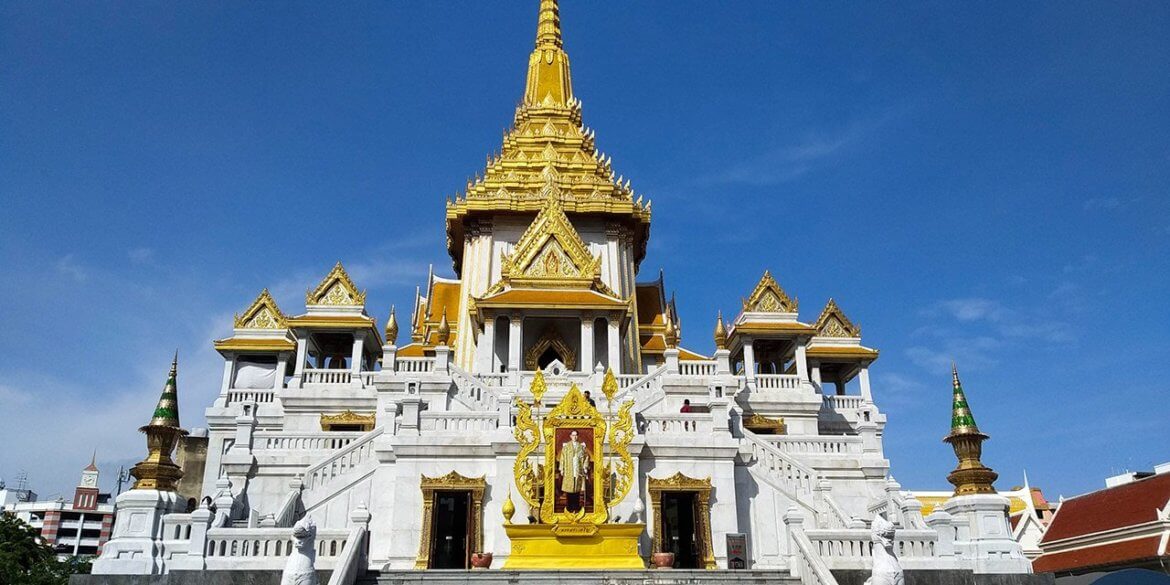
After moving the capita to Bangkok in 1782, King Rama I started to construct many temples in Bangkok. He ordered any Buddhas that still could be found in the ruins of Ayutthaya to be brought to Bangkok for installation. During the reign of King Rama II, the solid gold Buddha was first installed at Wat Chotanaram in Bangkok and later moved to Wat Trimitr when Wat Chotanaram was closed down. Originally called War Sam Chin Tai, Wat Trimitr and is one of the oldest temples in Chinatown. There were three Chinese men who were friends that helped construct this temple for the purpose of merit making. In 1939, the temple was renamed Wat Trimitr Witthayaram literally means three friends.

When the big Gold Buddha statute was moved to Wat Trimitr, the grounds were small and there was no place to display it. So, it as kept under a simple tin roof in storage and forgotten about for some 20 years. About 1954 a Viharn building had been constructed to house the big Gold Buddha. It was moved on 25 May 1955, then the Gold Buddha was discovered. It was found there were actually nine parts that could be disassembled using a key hidden in the base to allow for easier transport.

The statue is 3.01 metres wide, 3.91 metres in height and weighs 5,500 kilograms. On 14 February 2010, a large new building was opened at the Wat Trimitr Temple to house the Gold Buddha. The image remains one of Bangkok’s most visited tourist sites. It remains very fascinating.

0 comment
0 FacebookTwitterPinterestEmail

The worst thing any Thai can say about anything is that it’s “boring.” Happily for everyone, except a few clueless “farang” businessmen who never get the word about what to do (or wear) during the old Thai new year’s day celebration (and are always perfect targets for merry-makers being in a suit and tie), Songkran (Thai: เทศกาลสงกรานต์), also called the “Water Festival” is guaranteed fun. It marks the start of the new year on the solar or astronomical calendar and the astrological calendar.

Thailand’s old new year’s day is now celebrated on 13 April. It has become one of the most important national holidays. The holiday period usually extends for three days or even longer, depending if new year’s day falls on a weekend and if the Thai government approves the extension. The word “Songkran” is derived from the Sanskrit word “Sankranti”, an Ancient Hindu new year’s festival. It literally means astrological passage. It can also mean movement, transformation or change. It refers to the ascent of Aries from Pisces on the astrological chart or the start of the astrological new year. But astronomically, it coincides with the passage of the sun directly overheard in SE Asia or as it appears in the highest position in the sky on the earth’s transit around the sun.

The traditional western new year is now celebrated on 1st January in Thailand. But Songkran was celebrated as the official new year until 1888 when the new year’s day celebration was moved back to 1st April. In 1940, this date was finally shifted to the traditional western new year’s day celebration on 1st January in line with the modernisation programme in the country. Songkran then became a national holiday. Some researchers say technically the name should be “Maha Songkran” of “Great Songkran”. Each monthly passage of the zodiac marks the change from one astronomical month or sign to another. These passages are also referred to as a “Songkran”.

Normally here in Thailand Songkran lasts for three days. Astrologically, the first day of the celebration, 13 April, is called “Maha Songkran” or Great Songkran, the last day of the old year. The second day of the celebration, 14 April, is called “Wan Nao which is the transition day between the old and new year. The third day of the celebration, 15 April, is called “Wan Thaloeng Sok” which is the first day of the new year or the start of the new astrological era.

Since the actual solar year lasts about 365 1/4 days, Songkran has not always fallen on 13 April. There have been adjustments to the New Years Day over the centuries by periodically adding a day to the year to keep the astronomical and astrological years in alignment. For example, in the year 1600 Songkran was celebrated starting on 7th April. By the year 1900, the new year’s day celebration had been moved back to 12th April. In 1989, the Thai cabinet set Songkran as 12-14th April, in spite of the correct starting new year’s date of 13th April. In the west, this extra accumulation of time is added as one extra day every four years on 29th February in the years that are divided by four (i.e.; 2016, 2020, 2024, etc.) and another day for years that are divided by 400 on 30 February (i.e., 1600, 2000, etc.).

The Songkran festival is rich in symbolic traditions and meanings. In the morning there is merit making with offerings of food and other needed items to Buddhist monks and local temples, the most common way to start the celebration. In an old tradition that is still widely practiced, pouring water on Buddhist statues and on the hands of the monks. Also pouring water on the young and elderly is also a way of showing respect. This action symbolises the washing away of one’s sins and bad luck plus the purification. This festival is also a time when people who have moved away from their traditional villages return home to spend time with their family and friends. Paying reverence to ancestors is also an important part of the festival.

For better or worse, the time honoured traditions of sprinkling water on hands or shoulders has morphed into copious water throwing, especially by raucous teenagers, by the bucketloads on anyone lucky (or unlucky) enough to pass by. Few targets are spared, but overall Songkran means fun, and an enjoyable time for all.

0 comment
0 FacebookTwitterPinterestEmail